

A business website is often the first place customers interact with a company online. Whether someone is searching for a service, checking product information, submitting an enquiry, or making a purchase, they expect the website to load quickly and work smoothly.
A slow website can create a poor first impression and make visitors leave before taking an important action. It can also affect search visibility, mobile usability, and conversions. For businesses competing in Hyderabad’s growing digital market, website performance should therefore be treated as an important part of their online strategy.
Website performance optimization in Hyderabad involves improving the speed, responsiveness, stability, and technical efficiency of a website so visitors can access and use it more effectively.
This guide explains why website performance matters, what causes websites to become slow, how businesses can improve performance, and when professional optimization services may be useful.
What Is Website Performance Optimization?
Website performance optimization is the process of improving a website so that its pages load efficiently and respond quickly to user interactions.
It involves more than simply reducing page loading time. A properly optimized website should provide a smooth experience across different devices, browsers, screen sizes, and network conditions.
Performance optimization can include improving images, reducing unnecessary code, optimizing databases, using caching, improving hosting configuration, minimizing third-party scripts, and making the website easier for browsers to process.
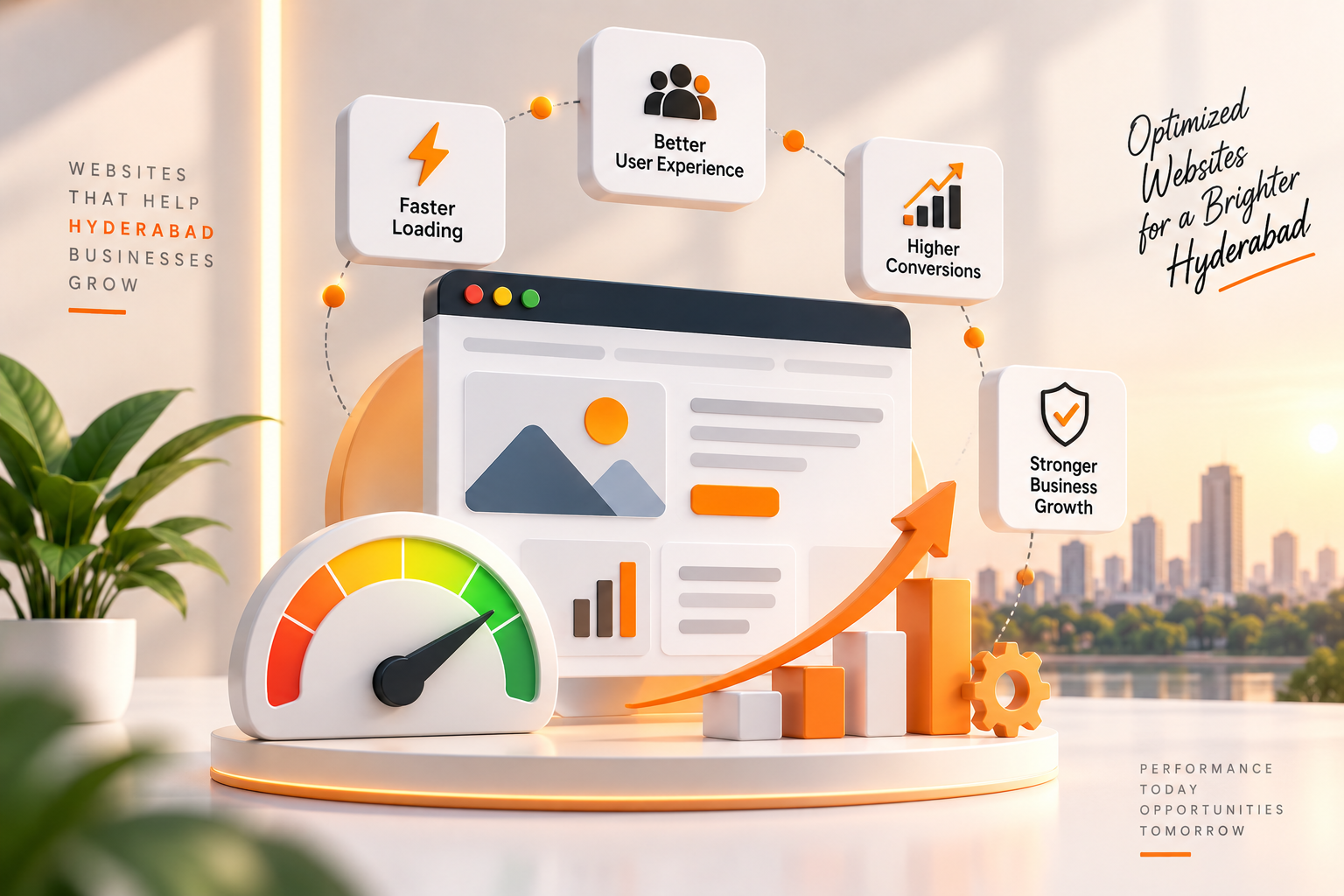
For businesses, the ultimate objective is not just a faster website. It is a website that loads efficiently, provides a better user experience, supports SEO, and helps visitors complete important actions.
Why Website Speed Matters for Businesses in Hyderabad
Hyderabad has businesses across industries such as technology, healthcare, education, real estate, restaurants, professional services, e-commerce, and startups. Customers often compare multiple businesses before making a decision.
If one website loads quickly while another takes several seconds to become usable, the faster website can provide a better experience.
Website performance can influence several areas of a business.
A fast website can make it easier for visitors to browse services, read content, view products, submit forms, and complete purchases. It can also contribute to better mobile experiences and support search engine optimization.
This makes performance optimization particularly important for businesses that depend on their website for leads, enquiries, bookings, or online sales.
How a Slow Website Can Affect Your Business
A slow website does not only create a technical problem. It can affect the way customers perceive a business.
When pages take too long to load, visitors may become frustrated and leave. For an e-commerce website, this can mean losing potential customers during product browsing or checkout.
For service businesses, a slow enquiry page may prevent users from submitting a form. For local businesses, poor mobile performance can make it harder for customers to find services, contact the business, or request directions.
Website speed can therefore influence the entire customer journey, from the first visit to conversion.
Common Causes of Slow Websites
Many factors can contribute to poor website performance.
Large Images
High-resolution images are important for visual quality, but unnecessarily large image files can significantly increase page size.
Images should be properly resized and compressed before being delivered to visitors. Modern formats such as WebP and AVIF can also help reduce image file sizes where appropriate.
Too Many Plugins
WordPress websites can become slower when they contain unnecessary or poorly optimized plugins.
Every additional plugin can introduce scripts, styles, database operations, or other processing requirements. Businesses should regularly review installed plugins and remove those that are unnecessary.
Unoptimized Code
Excessive CSS, JavaScript, unused code, and inefficient scripts can increase the amount of work required before a page becomes fully interactive.
Cleaning up unnecessary code and optimizing resource delivery can improve performance.
Poor Hosting
Website hosting has a significant effect on performance.
Shared hosting with limited resources may be sufficient for a small website at the beginning but can become a bottleneck as traffic and functionality increase.
Choosing appropriate hosting infrastructure based on the website’s requirements can improve reliability and response times.
Too Many Third-Party Scripts
Analytics tools, chat widgets, advertising scripts, social media integrations, tracking tools, and other third-party services can add additional requests and processing.
Businesses should only use scripts that provide genuine value and should load them efficiently.
Unoptimized Database
Websites with large databases can experience slower queries when data is not managed properly.
Regular database optimization and efficient queries can help improve backend performance.
Core Web Vitals and Website Performance
Google’s Core Web Vitals provide important user-experience measurements related to loading performance, responsiveness, and visual stability.
Three key metrics are:
Largest Contentful Paint (LCP) measures how quickly the main content of a page becomes visible.
Interaction to Next Paint (INP) evaluates how quickly a page responds to user interactions.
Cumulative Layout Shift (CLS) measures unexpected movement of page content while it loads.
Businesses should not optimize a website simply to achieve a particular score. The broader goal should be creating a fast, stable, and useful experience for real visitors.
Mobile Website Performance
Mobile performance is particularly important because many customers access business websites using smartphones.
A website that performs well on a desktop computer may still feel slow on a mobile device, especially when users have limited network speeds or less powerful hardware.
Mobile optimization should include responsive layouts, appropriately sized images, efficient code, readable content, easy navigation, and touch-friendly interactions.
Businesses should test their websites on different mobile devices rather than relying only on desktop testing.
Website Performance and SEO
Website performance is an important part of technical SEO and overall user experience.
Search engines consider many factors when evaluating websites, and performance-related signals can contribute to how users experience a page.
However, speed alone does not guarantee higher rankings. High-quality content, search intent, technical SEO, backlinks, local relevance, and other factors also matter.
For Hyderabad businesses, performance optimization should therefore be combined with a broader Local SEO strategy for Hyderabad businesses.
A fast website with useful, relevant content gives both users and search engines a stronger foundation.
Website Performance and Conversions
The purpose of business websites is usually to generate some type of action.
That action could be:
- Calling the business
- Submitting an enquiry
- Booking an appointment
- Purchasing a product
- Requesting a quotation
- Registering for a service
- Downloading information
Performance problems can create friction at any stage of this journey.
A website optimization strategy should therefore focus on both technical performance and conversion performance. A page should not only load quickly; it should also make it easy for visitors to understand what the business offers and what they should do next.
How to Improve Website Performance
Businesses can take several practical steps to improve website performance.
Optimize Images
Compress large images, resize them according to their actual display dimensions, and use modern image formats where suitable.
Lazy loading can also be used for images that are below the initial viewport.
Enable Browser Caching
Caching allows frequently requested resources to be stored temporarily so they do not need to be downloaded repeatedly.
Proper caching configuration can reduce loading times for returning visitors.
Minify CSS and JavaScript
Minification removes unnecessary characters from code files without changing their functionality. This can reduce file sizes and improve resource delivery.
Unused CSS and unnecessary JavaScript should also be reduced where possible.
Use Content Delivery Networks
A Content Delivery Network, or CDN, can distribute website resources through servers located in different geographical locations.
For businesses serving customers across Hyderabad, India, or international markets, a suitable CDN can help improve resource delivery.
Reduce Unnecessary Requests
Every additional resource can require another request from the browser.
Reducing unnecessary scripts, stylesheets, fonts, plugins, and external resources can help keep pages lightweight.
Improve Server Response Time
A website needs an efficient server and backend before the browser can display the content.
Businesses should review hosting performance, database queries, server configuration, caching, and application architecture when server response times are slow.
WordPress Website Performance Optimization
WordPress is widely used by businesses because it provides flexibility and makes content management easier. However, WordPress websites can become slower when they are overloaded with plugins, large images, unnecessary themes, or poorly configured services.
A WordPress performance optimization process can include:
- Removing unused plugins
- Updating WordPress and plugins
- Optimizing images
- Using caching
- Optimizing databases
- Reducing unnecessary scripts
- Improving hosting
- Using a CDN
- Optimizing themes
- Monitoring website performance
Businesses that need ongoing technical support can also consider professional Website Maintenance Services in Hyderabad.
E-Commerce Website Performance
Performance becomes even more important for e-commerce websites because customers may browse many product pages before making a purchase.
Large product images, filters, search functionality, payment integrations, tracking scripts, and inventory systems can all affect performance.
Businesses should optimize product images, caching, databases, search functionality, checkout processes, and third-party integrations.
A performance-focused e-commerce platform can provide a smoother shopping experience and reduce unnecessary friction during purchasing.
For businesses planning a new online store, E-Commerce Website Development Company in Hyderabad services can help address performance considerations during development rather than after launch.
How to Test Website Performance
Businesses can use several tools to evaluate website performance.
Google PageSpeed Insights can provide performance measurements and recommendations for individual pages.
Chrome DevTools can help developers investigate network requests, JavaScript execution, CSS, images, and other technical factors.
Lighthouse can evaluate performance and other aspects of a web page.
Google Search Console can provide information about Core Web Vitals and search-related performance.
Testing should be performed regularly because website performance can change after adding new plugins, content, scripts, images, or functionality.
Website Optimization vs Website Redesign
Not every slow website needs a complete redesign.
If the website has a good structure and only suffers from technical performance problems, optimization may be enough.
However, a redesign may be appropriate when the website has outdated technology, poor mobile usability, confusing navigation, weak conversion paths, or a design that no longer represents the business.
Businesses can review 10 Signs Your Business Needs a Website Redesign before deciding whether optimization or redevelopment is the better option.
How Much Does Website Performance Optimization Cost in Hyderabad?
There is no fixed price for website performance optimization because every website has different technical requirements.
A simple business website may require only image optimization, caching, code cleanup, and configuration improvements.
A larger website may require deeper backend optimization, database improvements, hosting changes, CDN configuration, application-level optimization, or redevelopment of inefficient components.
The final cost can depend on:
- Website platform
- Number of pages
- Website traffic
- Hosting infrastructure
- Number of plugins
- Technical complexity
- Database size
- Third-party integrations
- Existing code quality
- Required performance improvements
A professional audit before optimization can help identify the actual problems instead of making unnecessary changes.
When Should You Hire a Website Performance Optimization Company?
Businesses should consider professional help when their website remains slow despite basic optimization efforts.
Professional optimization can be especially useful when a website has:
- Poor mobile performance
- High page sizes
- Slow server response
- Complex functionality
- Large databases
- Many third-party integrations
- E-commerce functionality
- Poor Core Web Vitals
- High bounce or abandonment rates
- Frequent technical problems
A specialist can identify the underlying causes and create an optimization plan based on the website’s technology and business objectives.
Why Choose SJ CreativeWorks?
SJ CreativeWorks helps businesses improve their digital presence through website development, web applications, e-commerce solutions, SEO, digital marketing, and website maintenance.
Website performance should be considered as part of the complete digital experience rather than as an isolated technical task. A website needs to be fast, easy to navigate, mobile-friendly, secure, and designed around the needs of its visitors.
For businesses that require more advanced functionality, Web Application Development Company in Hyderabad services can help create scalable and performance-focused digital platforms.
Similarly, businesses with more complex software requirements can explore Custom Software Development Company in Hyderabad solutions.
Conclusion
Website performance optimization in Hyderabad is becoming increasingly important as customers expect fast and convenient online experiences.
A website that loads efficiently can provide a better experience across desktop and mobile devices, support SEO efforts, improve usability, and create a stronger foundation for conversions.
Businesses should regularly monitor performance rather than waiting until customers start experiencing problems. Image optimization, caching, efficient code, suitable hosting, mobile optimization, database management, and careful use of third-party services can all contribute to a better-performing website.
Whether you operate a small local business, e-commerce store, professional service company, or growing enterprise, investing in website performance can help ensure that your website remains ready to support your business in 2026 and beyond.